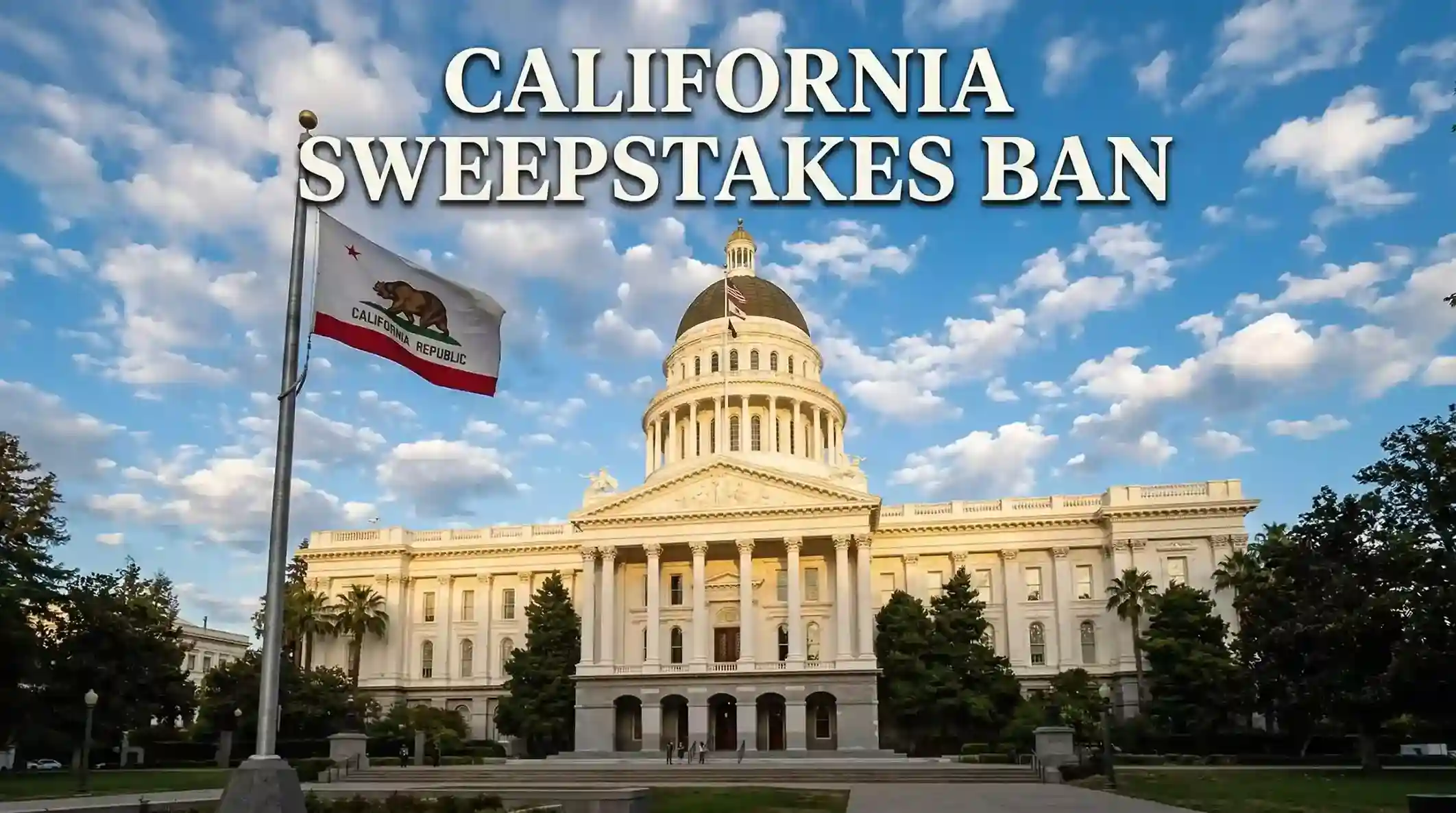
California became the first state to explicitly ban sweepstakes casinos when Governor Newsom signed AB 831 into law in October 2025. The legislation passed both chambers unanimously—a rare bipartisan consensus that reflected broad opposition to sweepstakes casino operations from tribal gaming interests, commercial gambling stakeholders, and state regulators alike.
The California ban impact extends far beyond state borders. California accounts for approximately 20% of sweepstakes casino revenues nationwide, making it the industry’s single largest market. Losing California forced major operators to restructure, triggered industry-wide revenue projections downward, and provided a template that other states are now considering for their own sweepstakes restrictions.
California Sweepstakes Casino Ban — More on this topic at social casino sweepstakes.
Timeline of AB 831
AB 831’s journey through the California legislature moved with unusual speed, reflecting the political consensus behind the measure and the urgency legislators felt about addressing sweepstakes operations.
Assembly Bill 831 was introduced in early 2025 by Assembly Member Gregg Hart. The bill proposed amending California’s gambling statutes to explicitly classify sweepstakes casinos as illegal gambling operations, closing what supporters characterized as a loophole that allowed casino-style gaming to operate without state licensing or tribal gaming compacts.
Committee hearings generated overwhelming support. Testimony from tribal gaming representatives, the California Gambling Control Commission, and consumer protection advocates painted sweepstakes casinos as unregulated competitors extracting revenue from Californians without providing the consumer protections or tax contributions that licensed gambling operations deliver.
The Assembly passed AB 831 unanimously—a rare achievement for any legislation in California’s often-divided legislature. The bill then moved to the Senate, where it again passed without opposition. The unanimous votes in both chambers reflected how thoroughly sweepstakes casinos had alienated potential allies in Sacramento.
Governor Newsom signed the bill in October 2025, with the ban taking effect January 2026. Operators received limited time to wind down California operations, notify affected players, and process final redemptions. The compressed timeline left little room for legal challenges or extended transitions.
Some operators attempted to continue serving California players despite the ban, testing enforcement appetite. California’s Gaming Control Commission and Attorney General’s office responded with cease-and-desist letters and enforcement warnings, making clear that continued operations would face consequences.
Why California Banned Sweepstakes
California’s sweepstakes ban emerged from a convergence of interests that rarely align so completely in gaming policy debates.
Tribal gaming opposition drove much of the legislative momentum. California’s tribal casinos operate under compacts with the state that grant exclusive gaming rights in exchange for regulatory compliance and revenue sharing. Sweepstakes casinos competing for the same players without similar obligations represented an existential threat to compact value. Tribal gaming generates billions in revenue for California tribes; protecting that revenue motivated substantial political engagement.
Commercial gambling interests—card rooms, licensed operators, and related businesses—joined tribal opposition. While sometimes at odds with tribal gaming on other issues, commercial operators shared concerns about unregulated competition. Bill Miller of the American Gaming Association has characterized sweepstakes operators as using “legal acrobatics to avoid calling themselves betting or gambling,” a framing that California legislators explicitly adopted in justifying the ban.
Consumer protection concerns provided additional rationale. Supporters argued that sweepstakes casinos operated without responsible gambling protections, age verification standards, or player dispute mechanisms that licensed gambling requires. Whether these concerns reflected genuine consumer harm or convenient justification for competition-based opposition, they provided politically useful framing.
Revenue considerations mattered as well. Sweepstakes operators paid no state gaming taxes, contributing nothing to California’s general fund while generating substantial revenue from California players. The contrast with licensed gambling—which contributes regulatory fees, taxes, and compact payments—made sweepstakes operations an easy target.
The legal argument centered on California’s constitutional gambling provisions, which reserve gambling authority to the state and to tribal compacts. Sweepstakes casinos’ claim to operate outside gambling law contradicted how California lawmakers understood their own regulatory framework.
Industry Impact
Losing California devastated industry revenue projections. With roughly 20% of national sweepstakes casino revenue coming from California players, the ban forced immediate and substantial business adjustments.
Major operators saw their addressable market shrink overnight. Chumba Casino, Pulsz, Stake.us, and others had to block California IP addresses, close California player accounts, and process redemptions for affected users. Some operators had invested heavily in California marketing, making the loss particularly painful.
Industry analysts revised projections downward. Eilers & Krejcik Gaming adjusted their 2025 net revenue forecast from $4.7 billion to $4 billion, with further declines projected for 2026. The California ban represented the largest single factor in these revisions, though regulatory pressure in other states contributed as well.
Investor confidence in the sweepstakes model weakened. Companies that had positioned sweepstakes operations as growth engines faced difficult questions about sustainability. The unanimous legislative passage suggested that political vulnerability extended beyond California—if even California’s divided legislature could agree on a ban, other states might follow.
The California ban impact demonstrated how quickly the regulatory environment could shift. Operators that had assumed sweepstakes models would remain viable indefinitely now faced existential questions. Some began exploring licensed gambling markets or alternative business models; others doubled down on remaining states while accepting reduced growth trajectories.
Employment effects rippled through the industry. Marketing teams focused on California needed reassignment or reduction. Customer support scaled down as player bases shrank. The human cost of the ban extended beyond corporate revenue lines.
Player Options Now
California residents who previously enjoyed sweepstakes casinos now face severely limited options for similar entertainment.
Licensed tribal casinos remain fully available throughout California. Physical casino visits offer slots, table games, and poker—the same game categories sweepstakes sites provided, though requiring travel rather than home access. For players who valued the convenience of online play, tribal casinos represent a compromise rather than a replacement.
Social casinos without prize redemption continue operating legally. Platforms offering play-money only games—no Sweeps Coins, no cash prizes—fall outside AB 831’s scope. These options provide game access without redemption potential, satisfying players primarily interested in entertainment rather than prize opportunities.
California’s legal card rooms offer poker and certain banked card games. These physical locations provide gambling entertainment but don’t replicate the slots and casino games that dominated sweepstakes platforms.
Fantasy sports and sports betting remain unavailable in California, leaving players without legal alternatives in those categories as well. California’s gaming landscape, despite significant tribal casino presence, offers fewer online options than many other states.
Some California players may attempt to access sweepstakes casinos through VPNs or by misrepresenting their location. This approach violates operator terms of service, likely violates California law, and creates redemption complications if players succeed in winning. Operators actively detect and block such attempts, and players caught face account closure and forfeiture of balances.
Future Outlook
California’s ban is unlikely to reverse anytime soon. The unanimous legislative support, combined with powerful tribal gaming interests, creates a political environment hostile to sweepstakes casino legalization.
Federal legislation could theoretically preempt state bans, but no such legislation appears imminent. The sweepstakes casino industry has begun lobbying efforts at both federal and state levels, but overturning California’s decision would require either federal intervention or a dramatic shift in state political dynamics—neither of which appears likely in the near term.
Other states are watching California’s approach. The unanimous passage and apparent enforcement success may encourage similar legislation elsewhere. States with strong tribal gaming interests, active gambling commissions, or political environments favorable to gambling regulation may follow California’s lead.
Industry adaptation continues. Some operators are investing in licensed gambling markets where they can operate legally. Others are pursuing state-level licensing arrangements in jurisdictions open to regulation rather than prohibition. The sweepstakes model may survive in some states while dying in others, fragmenting the national market that operators previously enjoyed.
For California players specifically, meaningful change would require either legislative reversal (politically unlikely), successful legal challenge (AB 831 was carefully drafted to avoid constitutional vulnerabilities), or federal preemption (not on any realistic legislative agenda). The practical outlook: sweepstakes casinos are gone from California for the foreseeable future.
Conclusion
AB 831 ended sweepstakes casino access for California’s nearly 40 million residents, removing the industry’s largest single market and providing a template other states may follow. The unanimous legislative passage reflected a rare political consensus driven by tribal gaming interests, commercial gambling opposition, and regulatory concerns about unregulated competition.
See also New York Sweepstakes Casino Restrictions.
The California ban impact continues reverberating through the industry. Revenue projections have declined, investor confidence has weakened, and operators face strategic questions about long-term viability in a regulatory environment that can shift this quickly.
For California players, legal alternatives are limited to physical casinos and social casino games without prize redemption. The convenience and accessibility that made sweepstakes casinos popular is gone—replaced by either travel requirements or entertainment options without redemption potential. That’s the new reality for California, and it may become reality for additional states as sweepstakes casino regulation evolves.