Sweepstakes casinos and real money online casinos offer remarkably similar gaming experiences. The slot machines look identical. The blackjack tables play by the same rules. The apps feel interchangeable. Yet these two models operate under fundamentally different legal frameworks, serve different geographic markets, and carry different implications for players who use them. Understanding the sweepstakes vs real money casino distinction matters more in 2026 than ever before, as regulatory pressure reshapes both industries.
The numbers tell a striking story. According to KPMG’s Sweepstakes Gaming Emerging Industry Primer, sweepstakes casinos remain accessible in more than 35 states, while fully legal iGaming operates in just seven: New Jersey, Pennsylvania, Michigan, West Virginia, Delaware, Connecticut, and Rhode Island. That five-to-one ratio in geographic reach explains why the model comparison matters for most American players, who can access sweepstakes platforms but not licensed online casinos.
This guide examines both models across every dimension that affects players: legal structure, geographic access, currency mechanics, prize redemption, player protections, tax treatment, and game selection. By the end, you’ll understand which model fits your circumstances and what tradeoffs each involves.
Sweepstakes vs Real Money Casinos — More on this topic at social casino sweepstakes.
Fundamental Model Differences
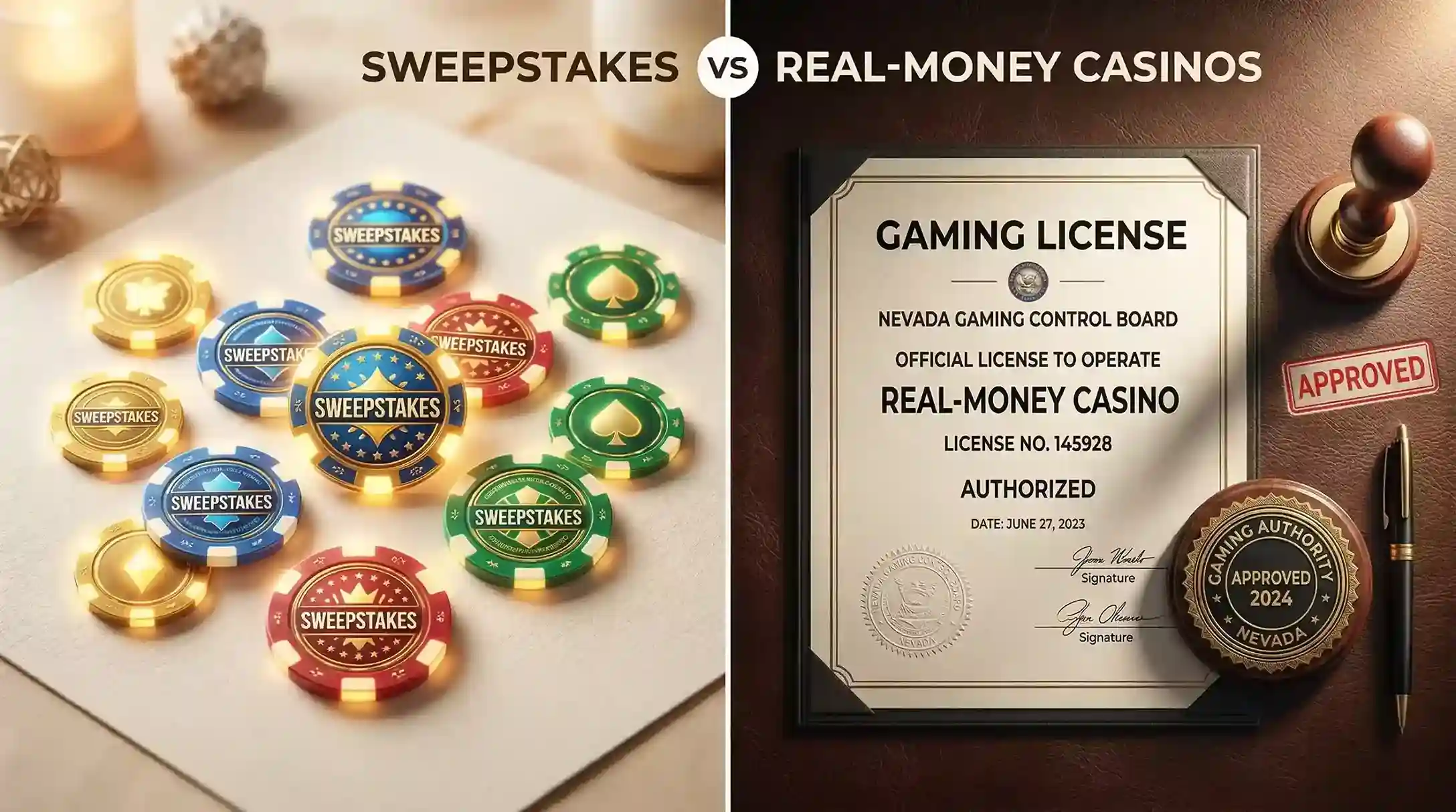
The core distinction between sweepstakes casinos and real money casinos comes down to a single legal concept: consideration. Traditional gambling requires three elements: consideration (something of value wagered), chance (random outcome), and prize (something of value won). Real money casinos satisfy all three. Sweepstakes casinos claim to eliminate consideration by structuring their platforms as promotional sweepstakes rather than gambling operations.
Real money casinos operate under explicit gambling licenses issued by state gaming commissions. These licenses come with substantial requirements: background investigations of operators, regular audits, mandatory responsible gambling tools, advertising restrictions, and ongoing regulatory oversight. Operators pay licensing fees, submit to compliance examinations, and face license revocation for violations. The regulatory framework establishes clear rules and enforcement mechanisms.
Sweepstakes casinos operate under a different theory entirely. They position themselves as promotional platforms offering entertainment products, with prize opportunities structured as sweepstakes contests rather than gambling. The dual-currency system, no-purchase-necessary requirements, and alternative methods of entry all exist to support this legal characterization. Whether regulators and courts accept this framing varies by jurisdiction and continues evolving.
The practical experience for players can feel nearly identical. Both offer slot machines, table games, and in some cases live dealer options. Both involve real money, whether through direct wagering or through purchasing virtual currency packages. Both create the possibility of winning cash or prizes. The fundamental differences lie in the legal structures underlying that experience and the regulatory protections, or lack thereof, that accompany each model.
Legal Access: 35+ States vs 7
Geographic availability represents the starkest contrast between these two models. Legal iGaming exists in seven states. Sweepstakes casinos operate in more than 35. For the majority of American players, the choice isn’t really a choice at all: sweepstakes platforms are the only option available.
The seven iGaming states cluster in the northeast and mid-Atlantic region: New Jersey, Pennsylvania, Michigan, West Virginia, Delaware, Connecticut, and Rhode Island. These states passed explicit legislation authorizing online casino gambling, established regulatory frameworks, and licensed operators to serve their markets. Players in these states can access both licensed real money casinos and sweepstakes platforms, giving them genuine choices about which model to use.
The remaining 43 states either prohibit online casino gambling outright or lack legislation specifically authorizing it. In most of these states, sweepstakes casinos filled the gap. Platforms like Chumba Casino, Stake.us, and dozens of others accept players from Texas, Florida, Ohio, Georgia, and other major population centers where real money online casinos cannot legally operate.
This geographic disparity drives the sweepstakes industry’s growth. According to data cited in Snell & Wilmer’s analysis, online sweepstakes platforms increased their player base at roughly three times the rate of real-money online casinos. The accessibility advantage explains much of that differential. When legal iGaming isn’t available, sweepstakes platforms become the default option for players seeking casino-style entertainment online.
The regulatory landscape continues shifting. California banned sweepstakes casinos effective January 1, 2026 following Governor Newsom’s signature on AB 831 in October 2025. New York’s Governor Hochul signed a ban into law in December 2025. More than 100 cease-and-desist letters went out from state regulators in 2025 alone. The current geographic availability snapshot may look different by the time you read this, as enforcement and legislation reshape which states allow which platforms.
Virtual Currency vs Real Money
The currency mechanics differ fundamentally between models, even though both ultimately involve real money. Understanding how each system works clarifies the legal arguments and practical differences players encounter.
Real money casinos operate exactly as their name suggests. Players deposit US dollars, wager US dollars, and withdraw US dollars. The money in your account is real money at every stage. Wins and losses occur in the same currency you started with. The straightforward currency structure means no conversion calculations, no separate coin types, and no ambiguity about what your balance represents.
Sweepstakes casinos use a dual-currency system designed to support their legal position. Players purchase Gold Coins with real money, but Gold Coins have no cash value and cannot be redeemed. When purchasing Gold Coin packages, players receive Sweeps Coins as a free bonus. Only Sweeps Coins can be redeemed for cash prizes after meeting certain conditions. The purchase ostensibly buys entertainment currency; the prize-eligible currency comes free.
This structure exists specifically to avoid the consideration element of gambling law. Operators argue that since players never directly purchase the coins used to win prizes, and since free entry methods exist through daily bonuses and mail-in requests, no consideration exists. The gambling transaction becomes a promotional sweepstakes.
From a player experience perspective, the dual-currency system adds complexity. You need to track two balances, understand which games accept which currency, and navigate the redemption process for Sweeps Coins. The effective exchange rate between your initial purchase and redeemable balance depends on the Gold Coin to Sweeps Coin ratios offered, which vary by package and operator. Real money casinos avoid this complexity entirely.
The risk profile also differs in important ways. At a real money casino, you wager money that could otherwise be in your bank account. Losses represent actual monetary losses. At a sweepstakes casino, you purchase entertainment products with money, receive promotional coins that can be redeemed for prizes, and your relationship to potential losses gets mediated through the dual-currency structure. Whether this distinction meaningfully affects player behavior or financial exposure remains debated.
Prize Redemption vs Cash Withdrawal
Getting money out of these platforms involves different processes, timelines, and requirements. The contrast illuminates practical differences players encounter when they win.
Real money casino withdrawals work like traditional banking transactions. You request a withdrawal in US dollars, the casino processes your request, and funds arrive in your chosen banking method. Processing times vary by operator and payment method, typically ranging from 24 hours to several business days. Licensed casinos must comply with banking regulations, anti-money laundering requirements, and know-your-customer protocols, all of which the regulatory framework standardizes.
Sweepstakes casino redemptions follow a different path. You redeem Sweeps Coins for cash prizes rather than withdrawing a cash balance. Most operators require identity verification before any redemption, often involving document uploads and review periods. Minimum redemption thresholds apply, typically requiring 50 to 100 Sweeps Coins before you can cash out. Some platforms impose playthrough requirements, meaning you must use Sweeps Coins in games a certain number of times before they become redeemable.
Processing timelines at sweepstakes casinos tend to run longer than at licensed real money casinos. First-time redemptions can take one to two weeks while identity verification completes. Subsequent redemptions may process faster but still typically require several business days. Some operators have faced criticism for slow payouts, though others maintain competitive processing speeds.
The verification requirements exist partly because sweepstakes casinos lack the regulatory infrastructure that licensed casinos operate within. Licensed operators have established compliance systems and regulatory oversight for identity verification. Sweepstakes operators must build these systems independently, sometimes with less consistency or transparency than regulated environments provide.
Player Protections Compared
The gap in player protections between licensed iGaming and sweepstakes casinos represents one of the most significant differences between these models. This gap has drawn increasing regulatory attention and explains much of the criticism sweepstakes platforms face.
Licensed online casinos operate under comprehensive responsible gambling frameworks established by state gaming commissions. These typically include mandatory self-exclusion programs that allow problem gamblers to ban themselves from platforms statewide. Deposit limits let players cap how much they can add to their accounts daily, weekly, or monthly. Loss limits restrict how much a player can lose in specified time periods. Cooling-off periods allow temporary account suspensions. Reality checks remind players how long they’ve been playing.
The American Gaming Association highlighted this contrast directly, stating that “the lack of regulatory oversight presents many risks for consumers as well as the integrity and economic benefits of the legal gaming market through investment and tax contributions.” The statement reflects the industry view that sweepstakes operators bypass standards that licensed operators must meet.
The National Council on Problem Gambling publishes Internet Responsible Gambling Standards that outline best practices for online gambling operators. Licensed casinos face pressure to comply with these standards through their regulatory relationships. Sweepstakes casinos face no equivalent regulatory pressure. Some implement responsible gambling tools voluntarily, but the extent and effectiveness of these tools varies widely across operators.
Self-exclusion represents a particularly significant gap. State gaming commissions maintain self-exclusion registries that licensed operators must honor. A player who self-excludes in Michigan cannot access any licensed online casino in the state. Sweepstakes casinos have no obligation to check these registries and typically don’t participate in them. A player struggling with gambling problems who self-excludes from licensed options can still access sweepstakes platforms.
Age verification also differs between models. Licensed operators must verify that players are at least 21 years old in most states before allowing real-money play. The verification processes are standardized and audited. Sweepstakes casinos implement age verification, but the processes lack regulatory standardization. Most require players to be 18 or older rather than 21, though some states impose higher age requirements that operators may or may not consistently enforce.
The player protection gap doesn’t mean all sweepstakes casinos are predatory or that all licensed casinos are exemplary. Individual operators in both categories vary in their commitment to player welfare. The structural difference is that licensed operators face regulatory requirements and oversight for player protections, while sweepstakes operators largely self-regulate.
Tax Treatment Differences
How winnings get taxed differs between models in ways that affect both players and government revenue. The tax implications add another dimension to the model comparison.
Real money casino winnings fall clearly under gambling income tax rules. Operators issue Form W-2G for winnings above certain thresholds, typically $1,200 for slot machine jackpots and $5,000 for table game winnings exceeding certain odds. Players must report all gambling income regardless of whether they receive a W-2G. They can deduct gambling losses against gambling winnings, but only up to the amount of winnings reported. The tax framework is well-established and consistently applied.
According to AGA’s State of the States 2025 report, commercial gaming generated a record $15.91 billion in direct gaming tax revenue in 2024, an 8.5% increase from the previous year. This tax revenue funds state programs and represents a significant contribution from the regulated gaming industry. Licensed iGaming contributes to this total through state-specific tax rates on gross gaming revenue.
Sweepstakes casino prize reporting operates in more ambiguous territory. Operators typically issue Form 1099-MISC for prizes exceeding $600, treating redemptions as sweepstakes prize income rather than gambling income. This classification has implications for loss deductibility. Gambling losses can only be deducted against gambling income, so if sweepstakes prizes are classified as miscellaneous income rather than gambling income, players may not be able to deduct their losses against those winnings.
The tax reporting mechanics for sweepstakes casinos remain less settled than for traditional gambling. The IRS hasn’t issued definitive guidance specifically addressing the dual-currency sweepstakes model. Players should consult tax professionals about their specific situations, as the rules may vary based on how platforms report prizes and how individual tax situations apply.
From a state revenue perspective, sweepstakes casinos contribute virtually nothing through gaming taxes. They aren’t licensed as gambling operations and don’t pay gaming taxes as a result. The American Gaming Association has criticized this asymmetry, noting that sweepstakes operators don’t contribute to the state tax revenue that licensed operators generate. Whether this reflects an unfair advantage or simply different business models depends on whether you view sweepstakes casinos as gambling operations subject to gaming taxes.
Game Selection Comparison
The games available at sweepstakes casinos and real money casinos overlap substantially but aren’t identical. Understanding the differences helps players know what to expect from each platform type.
Real money casinos in licensed states feature games from major software providers with established reputations. NetEnt, IGT, Playtech, and Evolution Gaming supply games to licensed operators. These providers undergo independent testing and certification. Game libraries at major licensed casinos often exceed several hundred titles, including slots, table games, video poker, and live dealer options. The games are the same titles you’d find at major casinos worldwide, with return-to-player percentages published and audited.
Sweepstakes casinos feature games from different providers, some well-known and others specific to the sweepstakes market. The game selection varies significantly by operator. Some sweepstakes platforms offer extensive libraries rivaling licensed casinos. Others feature more limited selections. The games often look and play similarly to their real money counterparts but may come from different providers or be developed specifically for the sweepstakes market.
Live dealer availability represents one area where licensed casinos generally lead. Live dealer games require substantial infrastructure and regulatory compliance. Major licensed casinos offer live blackjack, roulette, baccarat, and game shows streamed from professional studios. Some sweepstakes casinos have added live dealer options, but availability remains less widespread than in the licensed market.
Random number generator certification also differs between models. Licensed casinos must use RNG systems tested and certified by independent laboratories like GLI and BMM. The testing ensures games operate fairly and produce outcomes matching stated probabilities. Sweepstakes casinos may obtain similar certifications voluntarily, but no regulatory requirement mandates independent testing. Players have less assurance that games operate as advertised when regulatory oversight is absent.
Progressive jackpots and networked games also tend to differ. Licensed casinos participate in progressive jackpot networks that link games across multiple operators, creating larger prize pools. Sweepstakes casinos may offer progressive features but typically within their own platforms rather than across operator networks. The jackpot sizes reflect this difference.
Revenue Scale Comparison
The financial scale of these two industries reveals how significant the sweepstakes market has become and why regulators have taken increased interest.
According to the AGA’s State of the States 2025 report, U.S. iGaming gross gaming revenue reached $8.41 billion in 2024, a 28.7% increase year-over-year. This revenue comes from seven states over several years of operation. The iGaming market continues growing as existing states mature and operators refine their offerings.
The sweepstakes casino market operates at even larger scale despite, or perhaps because of, its broader geographic reach. KPMG’s industry primer, referencing Eilers & Krejcik Gaming data, reports that 2024 industry gross revenue exceeded $10.6 billion with net revenue surpassing $3.4 billion. This means the sweepstakes market now exceeds the legal iGaming market in gross revenue, despite lacking explicit legal authorization in most jurisdictions.
The revenue comparison highlights the market dynamics driving regulatory concern. An industry generating more revenue than licensed iGaming while operating outside traditional gambling regulation represents both a competitive threat to licensed operators and a potential source of consumer harm from inadequate oversight. The revenue scale also suggests significant untapped tax revenue from the state perspective.
Growth trajectories have diverged recently due to regulatory pressure. Eilers & Krejcik revised their sweepstakes market projections downward, anticipating 16% net revenue growth in 2025 instead of originally projected 36%, with an actual 10% decline projected for 2026 as major markets exit. Meanwhile, iGaming continues expanding both within existing states and potentially into new ones as more states consider legalization.
Which Model Suits You
Choosing between sweepstakes casinos and real money casinos depends on factors specific to your situation. The decision framework involves geography, risk tolerance, and what you prioritize in an online gaming experience.
If you live in one of the seven iGaming states, you have genuine options. Real money casinos offer regulatory protections, standardized responsible gambling tools, clear tax treatment, and established player protections. Sweepstakes casinos offer an alternative experience with different mechanics and potentially different game selections. You can choose based on preference rather than availability.
If you live outside the seven iGaming states, sweepstakes casinos represent the primary option for online casino-style gaming. The legal status may be ambiguous, and regulatory protections are limited compared to licensed alternatives. But for players in Texas, Florida, Ohio, or dozens of other states, the choice is sweepstakes platforms or nothing at all. Many players find that tradeoff acceptable.
Risk tolerance matters for both financial and legal dimensions. Real money casino play involves direct financial risk that’s clearly understood. Sweepstakes casino play involves purchasing entertainment products and receiving promotional coins, but the financial exposure functionally resembles gambling. On the legal side, sweepstakes platforms face increasing regulatory scrutiny, meaning access could change or operators could exit your state with limited notice.
Responsible gambling considerations deserve attention. If you struggle with gambling problems, the stronger player protection frameworks at licensed casinos provide more robust safeguards. Self-exclusion programs, deposit limits, and regulatory oversight exist specifically to help vulnerable players. Sweepstakes casinos may offer some of these tools voluntarily, but the coverage is less comprehensive and less consistently enforced.
Game selection and experience preferences also factor in. Some players prefer specific games or providers available only at certain platforms. Others prioritize mobile experience, payout speed, bonus structures, or customer service quality. These practical considerations matter alongside the structural differences between models.
Conclusion
Sweepstakes casinos and real money casinos serve similar entertainment purposes through fundamentally different structures. The sweepstakes model offers broader geographic access, reaching players in more than 35 states where legal iGaming doesn’t exist. The real money model offers clearer regulatory frameworks, stronger player protections, and established tax treatment, but only in seven states.
The $10.6 billion sweepstakes market now exceeds the $8.41 billion iGaming market in gross revenue, demonstrating player demand for online casino entertainment beyond the states where it’s explicitly licensed. That demand has driven industry growth but also attracted regulatory attention that may reshape the landscape.
For players, the model comparison comes down to circumstances and priorities. Geographic location determines what’s available. Risk tolerance shapes comfort with ambiguous legal status. Responsible gambling needs influence whether stronger player protections matter. Neither model is universally superior. Each involves tradeoffs that individual players weigh differently based on their situations.
Before choosing either option, understand what you’re choosing. Real money casinos mean licensed gambling with all its implications. Sweepstakes casinos mean promotional platforms that function like gambling but claim otherwise. Both involve real money, real prizes, and real risks. The structures differ, but the responsibility for informed decision-making remains with each player.
See also Top Sweepstakes Casino Operators.